
What does it take to respond to AI attacks?

With AI pentest frameworks like ARTEX, CyberStrikeAI and Cairn now showing up in real attacks, the demands on threat detection systems are only going up. An agent can get through an environment in hours rather than days, and it touches many more systems on the way. In essence, as a defender you need to move faster and run detections against more data than ever before.
Speed is the part that's discussed the most. As a matter of fact, it's hard to find a security vendor right now that doesn't promise machine speed, and SIEMs, XDR platforms, AI SOC startups, EDRs and more all say they detect and respond at it. Very few of them can actually do it, at least where detection is concerned. Most SIEMs still find threats by running scheduled queries against data that has already been ingested and indexed, and most AI SOC tools only start working once another tool sends them an alert.
As a matter of fact, when security marketing says machine speed, it usually describes what happens after an alert exists, like an agent triaging it in seconds instead of an analyst taking half an hour. That's a big improvement, but if the alert itself took 30 minutes or more to fire, faster triage doesn't change much for the attacker.
The data part gets a lot less attention. An agent decides its next step based on what it just found, so its path changes from target to target, and it's hard to know ahead of time which logs will hold the evidence. Detection has to run against a lot of data, including high-volume sources most SOCs never send to their SIEM. To respond to these attacks, you need fast detections running against far more data than SOCs typically have access to.
The trouble is that a traditional SIEM makes you pick between the two. Adding sources makes indexing more expensive and searches slower, and running rules more often adds load to the same search tier that analysts and AI agents rely on. In this post we go through how the AI attack frameworks work, and then look at how to get speed and coverage at once.
How AI attack frameworks work
Frameworks like ARTEX went from GitHub projects to incident reports within a few months. By early November more than a thousand ARTEX control panels were reachable from the internet, and several governments had issued warnings about it. Some of the first public cases involved South Korean banks. Since then it has been used against Microsoft 365 tenants and crypto platforms, among others.
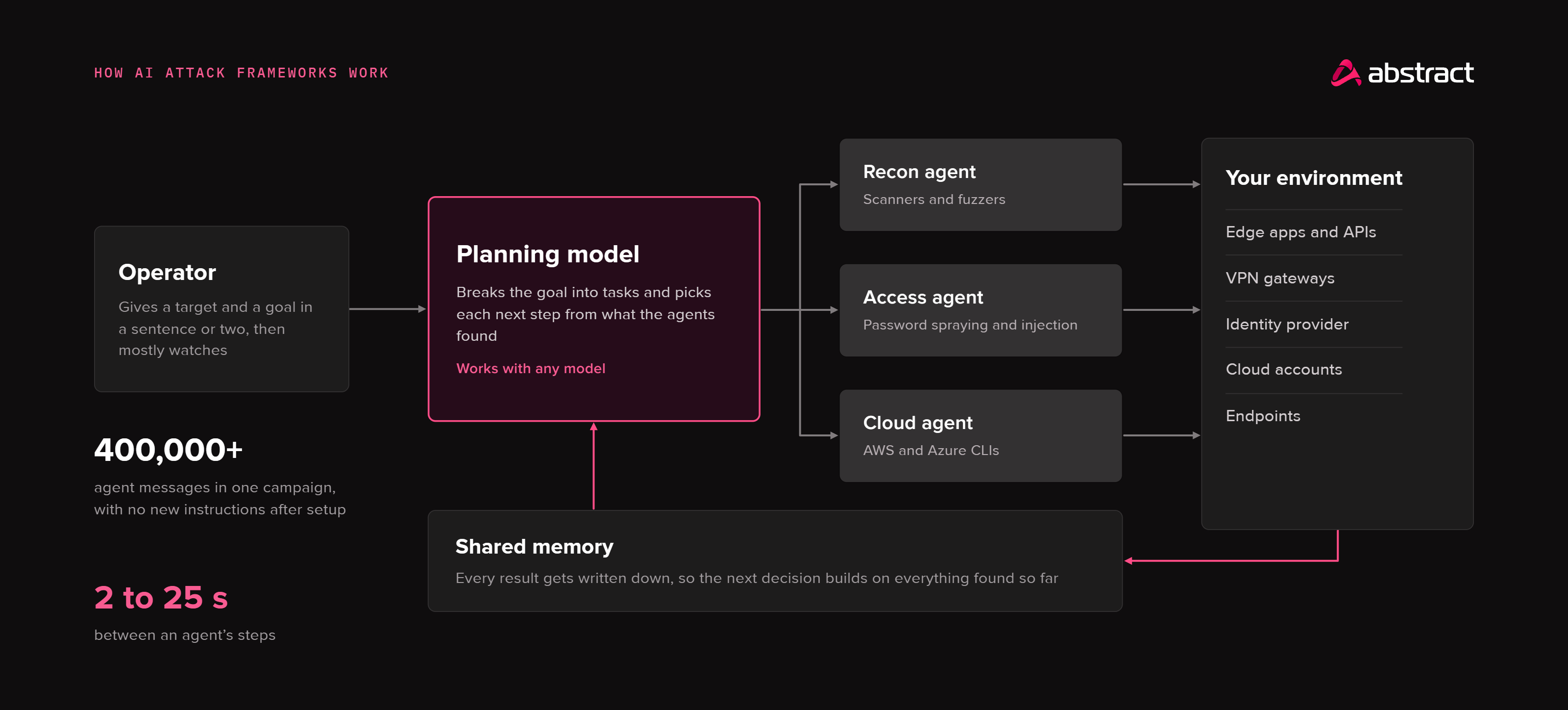
Most of these tools work the same way under the hood. A language model plans the attack and breaks it into tasks, and worker agents carry the tasks out with the open-source tooling a human pentester would use, things like nmap and sqlmap plus the usual cloud CLIs. Whatever the agents find goes into shared memory, so every decision takes the earlier findings into account. CyberStrikeAI comes with over a hundred tools out of the box.
The operator gives it a target and a goal in a sentence or two, something like "get credentials or a shell and try to reach the internal network," and from then on mostly watches. Researchers were able to look inside one criminal operation through the attacker's own exposed console. It ran close to 300 objectives and produced over 400,000 agent messages, and the operator didn't type a single new instruction after setup. Most of what they did send were questions about progress.
The frameworks work with whatever model gets plugged in. Operators have used DeepSeek, GLM, Grok and Claude, and when a model refuses they switch to a less restrictive one. Several of the tools tell the model in their prompts that the engagement is authorized, and some ship with the human approval step turned off. It's cheap to run as well. One operation against ten targets went on for about two weeks and used around 36 billion tokens, which comes to roughly $700 to $1,500 at public API prices.
How fast they move
An agent can act every few seconds. ARTEX has been seen working in bursts of 2 to 25 seconds, while a complete operation can run for hours or days. One group's successful Cairn runs took a little under a day on average.
Credentials get used almost as soon as they're found. In intrusions that have been investigated, agents pivoted about a minute after downloading a credential and checked more than 200 client secrets in around three minutes. A state-aligned group used ARTEX to try stolen app credentials against over 2,250 Microsoft 365 tenants, and in several of them it had privileged cloud access less than three hours after starting. The same group also ran a password spray that peaked at 2,900 failed logins a minute.
Why their path is hard to predict
The way in is usually something old: a password reset page, an API without authentication, an API spec left on a public site, a reused password or a key sitting in a server's startup script. Several of the documented intrusions didn't use a software vulnerability at all.
The difference is that the agent tries these against every exposed system at the same time and goes after whatever responds. Each step depends on the result of the last one, so the route through an environment is different every time. In one case, an agent that had been told to steal cryptocurrency found an unauthenticated API that returned cloud storage credentials. The bucket held the company's app downloads, and the agent went ahead and replaced one of them, which amounts to a supply chain attack the operator never asked for.
They change tactics when they get blocked, too. Some of the tools are written to retry through another proxy with a different user agent and to fall back to Tor if that fails, and one deployment deliberately limited its traffic per target so it wouldn't trip rate-based alerts. The code changes quickly as well. ARTEX had roughly 390 commits in its first ten weeks and CyberStrikeAI more than 2,400 in its first year, so the IP addresses and user agents tied to a framework go stale fast.
They're far from perfect. In the crypto campaign mentioned above, agents reported successful withdrawals because an API returned a success code, while the attacker's wallet stayed empty. People also still step in at times. In at least one intrusion the operator switched to a normal browser for the password reset and the first token request.
For defenders this means two things. You have minutes to respond rather than hours, and you can't count on the attack showing up in the handful of sources you watch most closely.
Why speed matters
Threat detection is, in essence, applying logic to data. In most environments the data has to be collected, parsed and indexed, or pulled from an API, before a rule can see it, and depending on the source that takes anywhere from minutes to hours.
Then the event waits for the rule's next run, which on a ten-minute schedule can mean ten more minutes. Then the query executes, and if the search tier is busy it sits in a queue first. Our last post, The AI Tailspin, covered how that queue wait climbs steeply as a cluster nears its concurrency limit.
Add those up, from the moment the malicious activity happened to the moment the rule fires, and a typical scheduled detection probably takes more than 30 minutes. That's a generous estimate, since it assumes logs arrive on time and the search tier isn't backed up. Many detection engineers also delay their search windows by a few minutes on purpose so late events aren't missed, and during an incident, when analysts and automation are all hitting the same cluster, it gets worse.
By then an agent may already have found a credential and used it to move somewhere else. Detection has traditionally been slower than that, and plenty of practitioners are skeptical of machine-speed detection because they know how long alerts take to fire.

Prevention is the traditional machine speed
In most environments, the controls that act within seconds are the preventive ones. EDR kills a process or conditional access refuses a sign-in, inline, before a person gets involved.
Whatever gets past them goes to the SIEM and waits for a scheduled search. Most organizations end up with a two-speed model where anything blockable is stopped immediately and everything else is found later, sometimes much later.
Prevention can't close that gap on its own. Each control only sees its own enforcement point, so an endpoint agent has no idea the same user signed in from a new country two minutes ago. Blocking controls are also tuned conservatively, because a false positive can stop a salesperson from opening a contract or break a deployment, so ambiguous activity gets allowed and logged instead.
A lot of what AI agents do doesn't even look ambiguous. Signing in with a valid password and an approved MFA prompt, or calling CreateAccessKey from an admin role, can't be blocked on sight without breaking normal work.
Detection will never be quite as fast as prevention, since it works from a record of something that already happened. What it can do is get as close as possible, so the attacks prevention lets through are caught in seconds instead of half an hour or more.
Why more data matters
Fast detection doesn't help much if it's watching the wrong logs. Since an agent picks its route as it goes and its indicators change every few weeks, you can't predict where the evidence will be. The behavior is more consistent, and it shows up at every stage of an intrusion, often in sources that never reach the SIEM.
At the edge
Internet-facing apps and APIs usually see the first activity. Patterns that come up again in investigations include:
- Bursts of requests about a second apart, followed by a pause of roughly half a minute while the agent waits on the model.
- A single IP switching clients within the same minute, sending requests with curl one moment and the AWS CLI the next.
- An API spec or JavaScript source map being downloaded, with requests to the routes it lists following almost immediately.
- Fake usernames tried before real ones, and placeholder emails or domains in form fields.
- The same request repeated at a fixed interval for days.
- Unrelated edge systems, VPN gateways and storage appliances for example, probed within the same hour.
In identity and self-service flows
Many of these intrusions start with identity, so password reset and registration flows need as much attention as the login page. Look for account-existence checks and reset requests coming in faster than a person could type, and for failed requests that come back corrected a few seconds later. One campaign generated over 151,000 failed sign-ins against 327 accounts in five days. Some frameworks also create their own accounts in your apps and then log in to them from several sessions at once.
In the cloud
Cloud audit logs show how quickly an agent works through access once it has some. In one AWS intrusion, credential checks landed in three different accounts in the same second. Later on, one role read the startup scripts of 56 instances in 141 milliseconds looking for secrets, and on another day a role decrypted a stored parameter and sent a remote command 29 seconds later.
In Microsoft 365, an agent signed in more than 200 times in under four minutes with four stolen app credentials, then went on to map the directory and change privileged roles without any user logging in. Agents also tend to check their own work. They read back nearly everything they write and test storage buckets by writing a file and deleting it again.
On endpoints and the network
Once there's an implant on a host, the endpoint activity looks like a sped-up version of an ordinary intrusion. In one case persistence was in place within two minutes and the domain was mapped over about five hours, with DCSync and Golden Ticket attacks coming later. On the network side you may see an implant beaconing every five seconds with no jitter, or DNS lookups to public callback services that the agent uses to check whether a host can reach the internet.
Most of these signals look minor on their own. One AI-run intrusion into AWS triggered 78 alerts across six rules over 16 days, all rated medium or low. The only link between them was the source IP, and the attacker disappeared for two weeks in the middle, so a correlation window of a few hours would never have tied them together.
The data sources you need
Endpoint telemetry and cloud control plane logs are usually collected already, and they cover the later stages. The earlier activity mostly lands in sources that are high volume or owned by other teams, and some of them are off by default. After one of these campaigns, the official response guidance asked affected organizations to look back several weeks through service principal sign-ins and key vault access. That only works if those logs were already being collected.
Why a SIEM struggles to do both
Most SOCs decide what goes into the SIEM based on budget. Endpoint and cloud control plane logs usually make it in. High-volume sources like WAF logs and DNS usually don't, because they're noisy and expensive to index. Scheduled rules can only search what was indexed, so detection coverage ends where the ingest budget ends, and that's pretty much where AI agents do their early work.
That's a problem with AI pentest frameworks. Tools like ARTEX and CyberStrikeAI don't follow a predictable path through an environment, or at least not one defenders understand yet. An intrusion might start in identity and end up in a cloud account that wasn't being watched closely.
Sending more data to the SIEM doesn't solve it. Bigger indexes mean slower queries, and the search tier hits its concurrency limit sooner, which is a big part of where the 30-minute delay comes from. Scheduling rules more often to catch fast attacks adds to the same load. With a SIEM alone, most teams can afford wide coverage or fast detection, but rarely both.
We're against storing more data than a security monitoring strategy calls for, since keeping logs "just in case" is expensive and mostly adds noise. But if you can't predict where an attack will end up, covering more ground has to get cheaper. Otherwise teams leave sources unmonitored to stay on budget.

Running detection in the pipeline
The way around this is to run detection before the data reaches the SIEM. A security data pipeline parses and enriches data as it arrives, and detection rules run on it right there, before anyone decides where it gets stored. Alerts and important events then go on to the SIEM. A full copy can go to low-cost storage for lookback and hunting, and repetitive noise gets summarized or dropped.
How it speeds things up
The 30-plus minutes spent getting data indexed and waiting for a schedule mostly go away, because the rule sees each event as it passes through the pipeline. The alert exists seconds after the activity, which cuts mean time to detect directly.
Response can start right away too. If an alert matches a known true-positive pattern or is high fidelity, containment such as isolating a host or revoking a session can run from the pipeline within seconds.
When a case needs an investigation, it starts with context already attached, because the pipeline adds what's known about the user and the asset before anyone looks at it. And since the detection never ran as a scheduled search, it didn't take up search capacity. Analysts and AI agents are querying a search tier that isn't busy running rules, which keeps mean time to respond down in the incidents that create the most load.
How it lets you see more
Building the SIEM on top of the pipeline also changes what coverage costs. Detections run on data in flight, so you don't have to pay to index a new source before you can detect on it, and the SIEM itself ends up cheaper to run.
That makes it practical to run detections on data you'd never have put in a SIEM. You can check every WAF request for the burst-and-pause pattern or for a client switching tools mid-minute, and forward only the matches with a per-source summary. You can count password reset and registration events per source across all of your apps, which is how you catch a campaign that stays under the rate limit on each one. For cloud data events, a rule can be as simple as one identity reading startup scripts from more than 20 instances within ten minutes.
The low-cost copy is just as important. Agents act in seconds, but operations can run for weeks, and some operators go quiet for two weeks before coming back. If the earlier activity isn't searchable anymore, you lose the thread. The copy also lets you hunt back through older data when new indicators for a framework get published.
Inspecting data and storing it are separate decisions. A pipeline lets you look at everything once as it passes through, then keep what your monitoring strategy needs plus a cheap copy for later.
Swarm attacks, where many automated agents probe an environment at once, are where this matters most. The worst case is a SIEM that throttles or charges per query right when activity spikes, which is why we want to focus on unlimited data ingestion, unlimited searches and API queries during swarm attacks.
So machine-speed detection does exist, but only when detection runs before the data lands in the SIEM. Running it there is also what lets it cover enough of the environment to keep up with an AI agent.
How Abstract shortens MTTD and MTTR at the same time
Most tools work on one end of an alert's life. SIEM vendors focus on faster search and AI SOC products focus on faster triage. Handling an alert has two parts, though, the time it takes for the alert to exist and the time it takes to resolve it, and speeding up only one leaves the other as the bottleneck. Abstract works on both.
On the MTTD side, detections run in-stream in Abstract's pipelines before anything is written to storage. Alerts fire seconds after the activity and don't compete with investigations for search capacity. Because the detections run on the pipeline, they also cover edge and identity sources that would never fit in a SIEM budget, which is where AI agents tend to show up first.
On the MTTR side, high-confidence detections can trigger containment, like isolating a host or revoking a session, straight from the stream. Everything else arrives with context about the identity and asset involved, so Astro AI can start investigating as soon as it fires. Teams running their own agents get the same data through the Abstract MCP server, and Abstract Lake keeps a full copy for anything that needs a longer look back.

Shortening both means less time between an attacker's first action and containment. A fast agent waiting on a 30-minute alert still gives the attacker most of that time, and so does a fast alert sitting in a queue.
FAQ
What is machine-speed detection?
It's detection that runs on events while they pass through a data pipeline, before they get stored. Alerts can fire within seconds. A scheduled SIEM search usually takes 30 minutes or more once you count ingest delay and the wait for the next run.
Why do AI attacks need both faster detection and more data?
Agents act within seconds and decide where to go next based on what they find. Detection has to be quick enough to act on, and it has to cover enough of the environment that the activity is visible in the first place.
If prevention already acts in seconds, why isn't that enough?
Preventive controls only see their own piece of the environment, and they're tuned so they don't block normal work. An attacker using valid credentials or ordinary API calls usually gets past them, and then nothing notices until the next scheduled search runs.
What is ARTEX?
ARTEX is an open-source AI penetration testing framework, written in Go and released in mid-2026. A planning model splits a goal into tasks, and agents work through them using standard offensive tools. Its author made it closed-source after it was used against South Korean banks, but forks were already circulating, and it has been seen in intrusions in many countries since.
How can you tell an AI agent from a human attacker in the logs?
No single event proves it. What usually gives it away is a mix of things, like bursts of requests with half-minute pauses in between, fake usernames, one IP switching between clients within a minute, and failed requests that get fixed within seconds.
What does it mean to shorten MTTD and MTTR at the same time?
MTTD is how long it takes from the attacker's action to an alert, and MTTR is how long it takes from that alert to containment. Detecting in-stream brings the first down from tens of minutes to seconds. Containing in the stream, with context already attached to the alert, brings down the second.
Why build a SIEM on a data pipeline?
Mostly because it lets you have speed and coverage together. Detections run on data in flight, so they fire in seconds, and you can watch high-volume sources like WAF logs and DNS without paying to index all of them.
How does Abstract do it?
Abstract runs detections in-stream in its pipelines and can contain high-confidence alerts on the spot. Alerts come with context attached, and Astro AI picks each one up as soon as it fires.
ABSTRACTED
We would love you to be a part of the journey, lets grab a coffee, have a chat, and set up a demo!
Your friends at Abstract AKA one of the most fun teams in cyber ;)

Your submission has been received.