
The AI Tailspin: Why Agents Bolted to a Legacy SIEM Make Every Investigation Slower

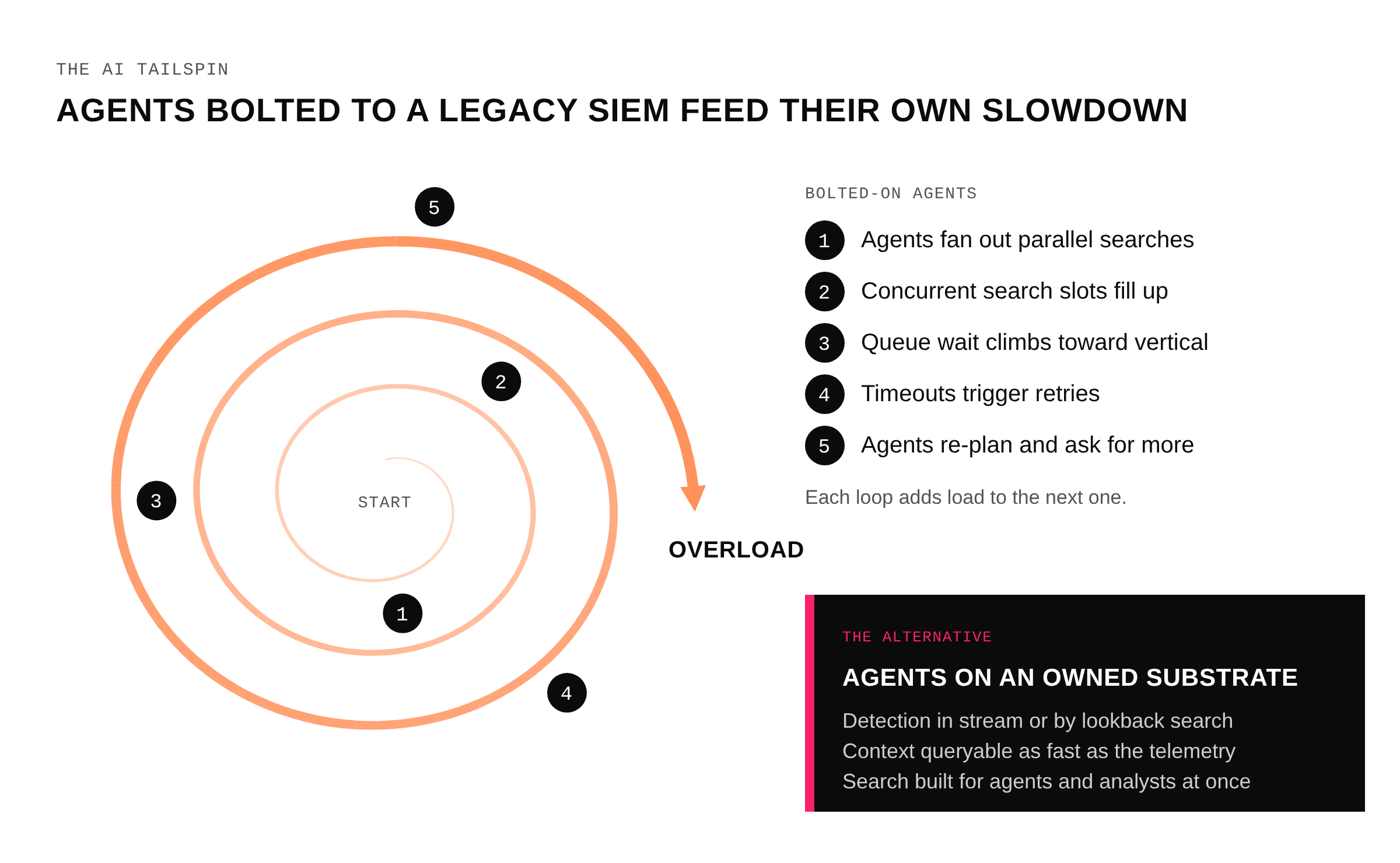
The AI tailspin is what happens when a security team wires dozens of (or even just a few tenacious) AI agents into a legacy SIEM that was already too slow for its human analysts. Every agent investigation turns into a burst of machine-generated searches, often parallelized for more perceived speed.
The search tier queues them, the agents wait, time out, retry, and ask follow-up questions. That extra load slows every search behind it. The loop feeds itself until investigations take longer than they did before the agents showed up. Eventually, you end up having to call the database performance engineers in to give you the bad news: the cluster is unhealthy now and you've got to either add more resources immediately, or stop querying the data until the db cluster gets back to a healthy state.
The ironic part is, this actually happens frequently at the most inopportune time: during a live incident. Your team is already pressed for time, and now you're stuck waiting for the system to become stable again.
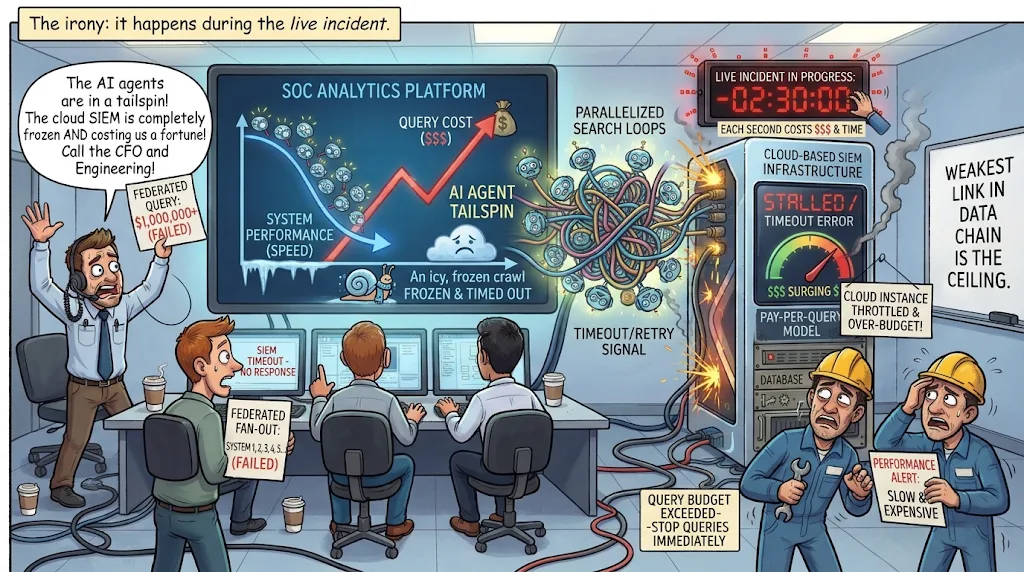
An AI SOC is only as strong as the weakest link in the data chain underneath it. If the agents depend on someone else's alerts, someone else's search head, or a federated fan-out across five systems they do not control, the slowest and least reliable of those systems sets the ceiling. The fix sits below the agents, in who owns the data substrate they reason over.
How a legacy SIEM goes into a tailspin
Legacy SIEM search was sized, priced and performance tuned for people. An analyst runs a search, reads the results, thinks, and runs another one, so the search tier gets a few queries a minute per person and plenty of idle time between them. Concurrent searches are typically a few dozen at most. Ask any incident responder at a large enterprise what slows them down most and you hear the same answer: waiting on searches that sit in a queue in the middle of an investigation.
An agent works differently. It decomposes one alert into many questions (who is this user, what else did this host do, has this IP shown up before, what changed in the last 24 hours) and fires them in parallel. A handful of agents working the morning queue can put more concurrent searches on the cluster in a few minutes than the analyst team puts there in an hour. The search tier has a fixed number of concurrent search slots, so the excess waits in line, while the database performance degrades.
Queueing theory explains why it gets worse instead of leveling off. In the simplest queueing model, a single server with random arrivals and random query times, the time a query spends waiting in line grows with utilization divided by the capacity that is left:
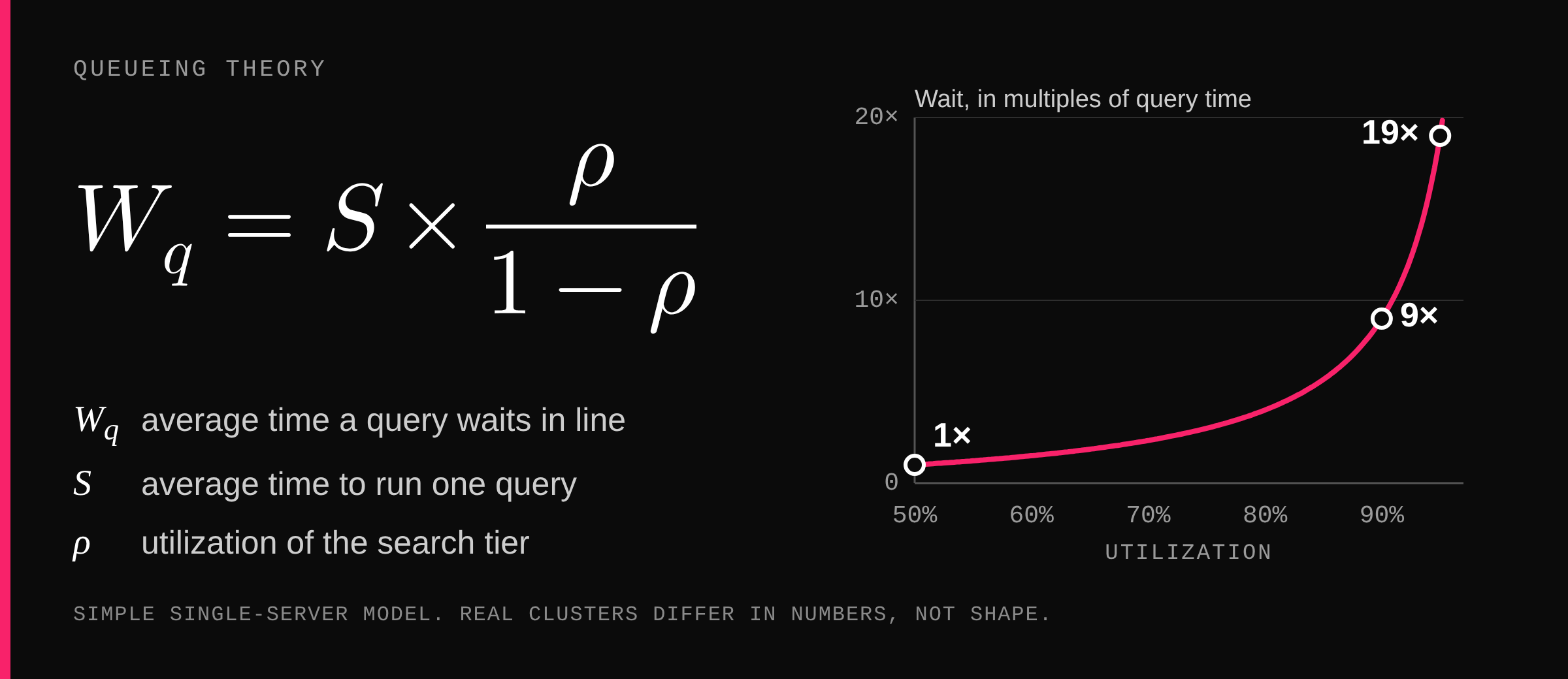
Here ρ is utilization and S is the average time to run one query. At 50% utilization a query waits about one query's worth of time before it starts. At 90% it waits nine, and at 95% nineteen. A real search cluster has many workers, shards, and caches, so its numbers differ, but the shape holds: the closer a system runs to capacity, the more each additional query costs in latency, and wide variation in query cost makes it worse. Agent queries are that kind of load: concurrent, iterative, and uneven, from a quick lookup to a 90-day scan. A team can buy headroom with more capacity, concurrency limits, or workload isolation, but each of those costs money or slows the agents down, on a platform sized and priced for human search.
Then the agents react to the latency, and this is where the spiral starts. A slow search hits a timeout and gets retried. Did it need to be retried, or is it technically still running and consuming resources, while the client has already timed out? A partial result makes the agent ask a narrower follow-up. A stalled investigation gets re-planned from the top. Each of those reactions adds load to a system that is already saturated, which makes the next search slower, which triggers more retries. An agent that waits on each answer slows itself down; the trouble starts when timeouts trigger retries, fan-out runs in parallel, and new alerts keep opening investigations while the old ones are still running. Distributed systems engineers call this a metastable failure: the system stays degraded after the original trigger is gone, because the recovery behavior itself sustains the overload. Operations teams have already watched a legacy SIEM fall over after machine-driven detection engines were pointed at it, and agents generate far more query volume than a detection engine does.
The humans feel it first. The analyst who needs one search to close a case now waits behind hundreds of agent queries, and the SOC ends up slower with AI than without it.
You are only as strong as the weakest link
The tailspin is one symptom of a broader problem: AI bolted onto data it does not own. Most AI SOC tools sit on top of the stack and consume what other products hand them. They triage another tool's alerts, query another tool's search head, and pull context through another tool's API. Whatever is wrong underneath (noisy detections, missing sources, short retention, rate-limited APIs, a search tier already at capacity) becomes the agent's problem, and the agent has no way to fix it.
Fully federated architectures have the same weakness spread across more systems. A federated query fans out to every place the data lives and returns when the slowest system answers. Each source brings its own rate limits, retention window, and query language, and each one can be down, throttled, or busy with someone else's workload. Reliability multiplies down the chain. Five sources that each answer on time 95% of the time answer together on time about 77% of the time, and an agent asking ten questions per investigation hits the slow path on almost every case.
Agents make federation worse in the same way they make a legacy SIEM worse. They query more often, in parallel, and they retry on failure, so a design that was tolerable when one analyst ran an occasional federated search becomes a source of API throttling and timeouts at machine speed. Federation is the right tool for data you cannot or should not move, and it works best as a deliberate exception rather than the foundation the agents stand on.
Own the substrate, then add the agents
Abstract was built so the agents and the data live in the same place. The platform owns the full path from collection to investigation, which means an agent never has to borrow capacity from a system designed for something else.
- Pipelines collect, parse, enrich, and reduce data in the stream across around 400 integrations that Abstract builds and maintains. Enrichment that belongs on the event is added as the data moves, and everything else stays live and queryable.
- Active context sits in the platform next to the telemetry: identity, asset, vulnerability, and threat context, all queryable as fast as the data itself. When an agent needs to know who owns a host, what a user normally touches, or whether a vulnerability is being exploited, it gets the answer from the same platform at the same speed, instead of making another API call to an identity provider, a CMDB, or a scanner.
- Detections run two ways on the same data. In-stream correlation runs in memory before data is written, delivers verdicts in seconds, and never competes with investigations for search capacity. Lookback searches catch slower patterns, such as behavior that only stands out over a month.
- Abstract Lake keeps full-fidelity data at object-storage cost, with a performance tier for fast search. Federated Search covers the data that should stay where it lives, used as a deliberate choice rather than as the default path for every agent question.
- Astro AI runs inside the platform on a harness Abstract built for agents. It works every alert in the queue on top of the findings, insights, and entity context the platform already holds, so an investigation starts from the full picture instead of rebuilding it with dozens of searches.
- The Abstract MCP server gives a customer's own agents access to the same data and context. Teams building their own AI get a substrate designed for machine access instead of a queue behind their analysts.
The difference shows up in where the work happens. In the bolted-on model, every agent question becomes a new search against someone else's system, and every piece of context is another API call to another tool. In Abstract, telemetry, context, and detections live in one platform built for machine access. Stream detections take time-critical work off the search tier, while lookback detections and agent searches run against a store designed to serve agents and analysts at the same time. Load from agents stays proportional to the work instead of compounding on itself, and the analyst who needs one search still gets it right away.
Five questions to ask before you connect agents to your SIEM
- How many concurrent searches does the SIEM allow today, and how close to that limit does the team already run at peak?
- How many searches does one agent investigation generate, and what happens to analyst searches when ten investigations run at once?
- What does the agent do when a search times out or comes back partial: retry, re-plan, or stop?
- Which detections and alerts does the AI depend on, and who owns their quality?
- If the design is federated, which source is slowest, what are its API rate limits, and what does the agent do when it gets throttled?
If the answers are unknown, run the test before the rollout. Point a few agents at the SIEM during the busiest hour of the week and watch analyst search latency. That number tells you whether you are buying an AI SOC or a tailspin.
FAQ
What is the AI tailspin?
The AI tailspin is a self-reinforcing slowdown that happens when AI agents query a legacy SIEM built for human search volume. Agent queries saturate the search tier, latency rises, agents retry and ask more questions, and the added load slows every search further.
Why do AI agents slow down a legacy SIEM?
Agents break each investigation into many parallel searches and react to slow results with retries and follow-up queries. Legacy SIEMs have a fixed number of concurrent search slots, so queue wait time climbs sharply as utilization approaches capacity.
Does federated search solve the problem?
Federated search moves the problem rather than removing it. A federated query is as fast as the slowest source it touches and is subject to every source's rate limits, so agents running at machine speed hit those limits sooner.
What does owning the data substrate mean for an AI SOC?
It means the platform running the agents also collects, enriches, detects on, and stores the data they use, along with the identity, asset, vulnerability, and threat context around it. Detection runs in the stream or as a lookback search, whichever fits the use case, and agents query data and context on a platform designed for machine access.
How does Abstract run AI agents?
Abstract runs Astro AI on its own agent harness inside the platform, on top of data from its pipelines, in-stream detections, and Abstract Lake. Customers' own agents connect through the Abstract MCP server to the same data and context. Learn more at https://abstract.security.
ABSTRACTED
We would love you to be a part of the journey, lets grab a coffee, have a chat, and set up a demo!
Your friends at Abstract AKA one of the most fun teams in cyber ;)

Your submission has been received.